





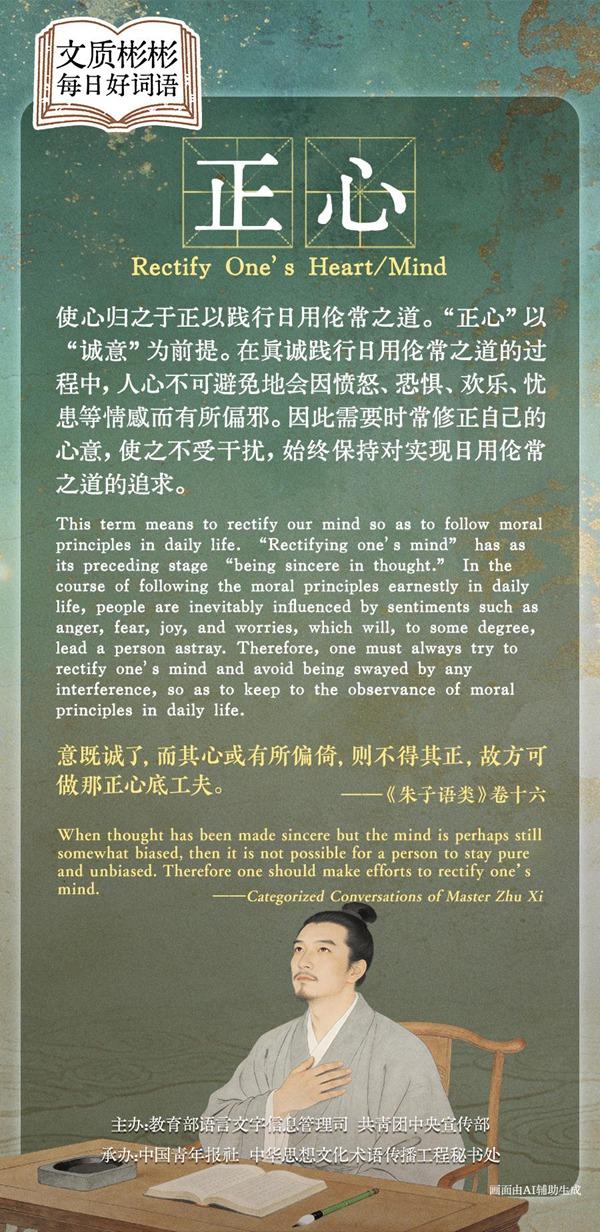
正心
使心归之于正以践行日用伦常之道。出自《礼记·大学》,与格物、致知、诚意、修身、齐家、治国、平天下并称“八条目”,是儒家所倡导的道德修养的一个重要环节。“正心”以“诚意”为前提。在真诚践行日用伦常之道的过程中,人心不可避免地会因愤怒、恐惧、欢乐、忧患等情感而有所偏邪。因此需要时常修正自己的心意,使之不受干扰,始终保持对实现日用伦常之道的追求。
Rectify One's Heart / Mind
This term means to rectify our mind so as to follow moral principles in daily life. Rectifying one's heart or mind is one of the eight notions from the philosophical text The Great Learning (a section of The Book of Rites), the other seven being studying things, acquiring knowledge, being sincere in thought, cultivating oneself, regulating one's family well, governing the state properly, and bringing peace to all under heaven. These constitute important stages in the moral cultivation advocated by the Confucian school. "Rectifying one's heart or mind" has as its preceding stage "being sincere in thought." In the course of following the moral principles earnestly in daily life, people are inevitably influenced by sentiments such as anger, fear, joy, and worries, which will, to some degree, lead a person astray. Therefore, one must always try to rectify one's mind and avoid being swayed by any interference, so as to keep to the observance of moral principles in daily life.
引例
著实致其良知而无一毫意、必、固、我,便是正心。(《传习录》卷中)(切实地发挥良知而没有一丝妄测、武断、固执、自我之心,这便是“正心”。)
To rectify one's mind means to cultivate one's good conscience without the least conjecture, arbitrariness, stubbornness, or egoism. (Records of Great Learning)
秦珍子 张玉佳来源:中国青年报
2026年05月07日 01版
 放大
放大 缩小
缩小 全文复制
全文复制 上一篇
上一篇