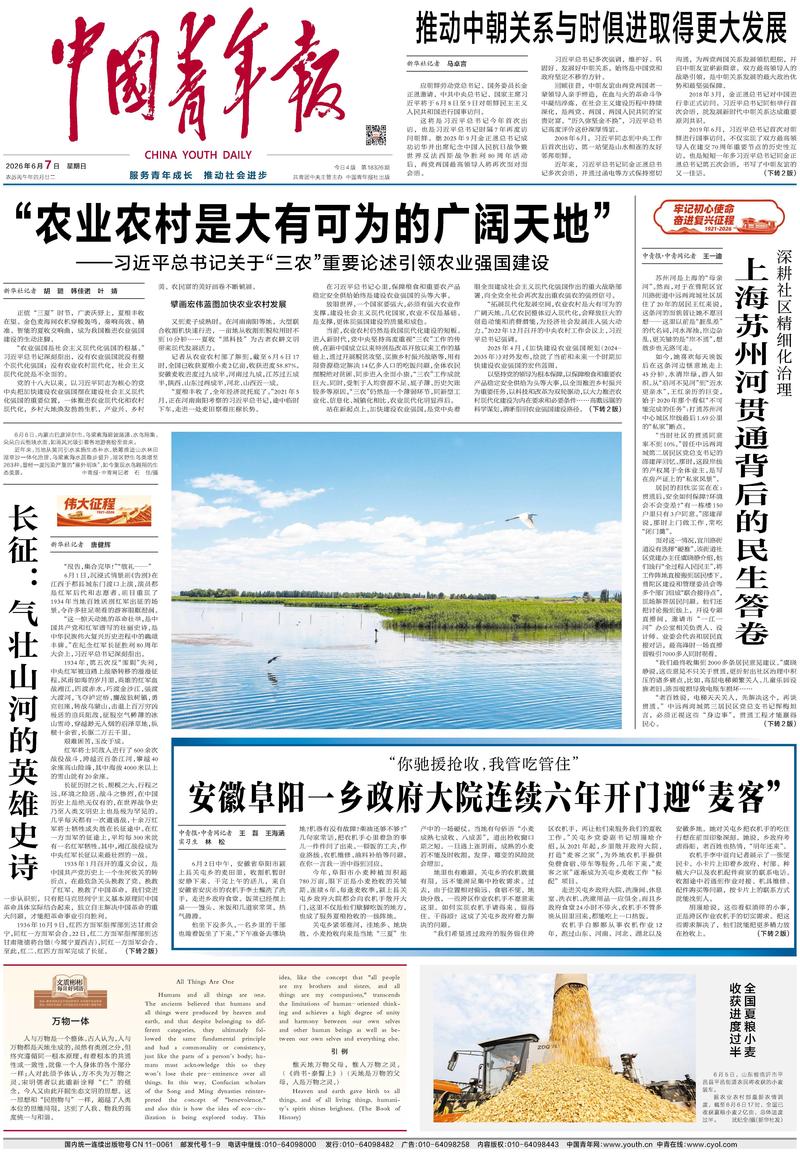





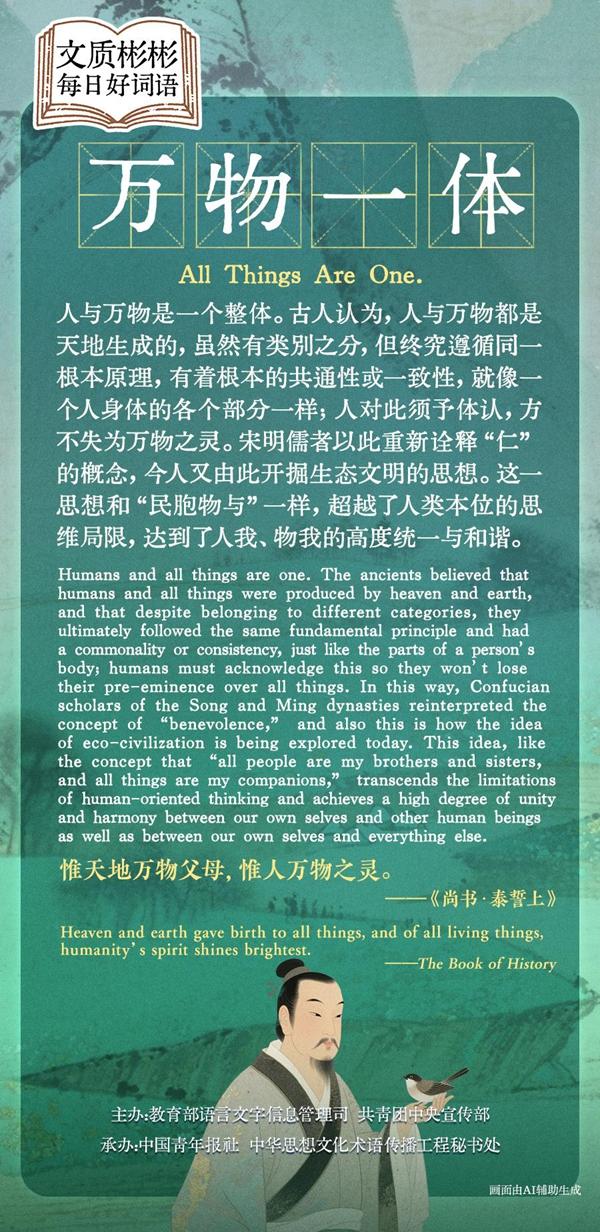
万物一体
人与万物是一个整体。古人认为,人与万物都是天地生成的,虽然有类别之分,但终究遵循同一根本原理,有着根本的共通性或一致性,就像一个人身体的各个部分一样;人对此须予体认,方不失为万物之灵。宋明儒者以此重新诠释“仁”的概念,今人又由此开掘生态文明的思想。这一思想和“民胞物与”一样,超越了人类本位的思维局限,达到了人我、物我的高度统一与和谐。
All Things Are One
Humans and all things are one. The ancients believed that humans and all things were produced by heaven and earth, and that despite belonging to different categories, they ultimately followed the same fundamental principle and had a commonality or consistency, just like the parts of a person's body; humans must acknowledge this so they won't lose their pre-eminence over all things. In this way, Confucian scholars of the Song and Ming dynasties reinterpreted the concept of "benevolence," and also this is how the idea of eco-civilization is being explored today. This idea, like the concept that "all people are my brothers and sisters, and all things are my companions," transcends the limitations of human-oriented thinking and achieves a high degree of unity and harmony between our own selves and other human beings as well as between our own selves and everything else.
引 例
惟天地万物父母,惟人万物之灵。(《尚书·泰誓上》)(天地是万物的父母,人是万物之灵。)
Heaven and earth gave birth to all things, and of all living things, humanity's spirit shines brightest. (The Book of History)
来源:中国青年报
2026年06月07日 01版
 放大
放大 缩小
缩小 全文复制
全文复制 上一篇
上一篇