 上一版
上一版





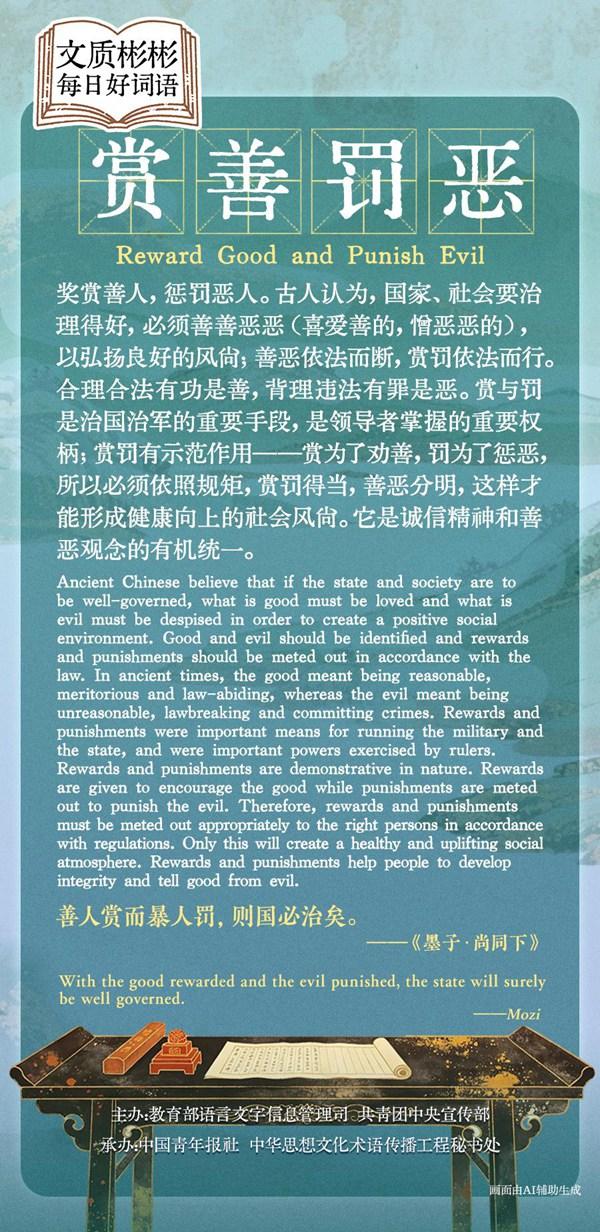
赏善罚恶
奖赏善人,惩罚恶人。古人认为,要治理好国家、社会,必须善善恶恶(善待善者,憎恶恶者),以弘扬良好的风尚;善恶依法而断,赏罚依法而行。合理合法有功是善,背理违法有罪是恶。赏与罚是治国治军的重要手段,是领导者掌握的重要权柄;赏罚有示范作用——赏为了劝善,罚为了惩恶,所以必须依照规矩,赏罚得当,善恶分明,这样才能形成健康向上的社会风尚。它是诚信精神和善恶观念的有机统一。
Reward Good and Punish Evil
Ancient Chinese believe that if the state and society are to be well-governed, what is good must be loved and what is evil must be despised in order to create a positive social environment. Good and evil should be identified and rewards and punishments should be meted out in accordance with the law. In ancient times, the good meant being reasonable, meritorious and law-abiding, whereas the evil meant being unreasonable, lawbreaking and committing crimes. Rewards and punishments were important means for running the military and the state, and were important powers exercised by rulers. Rewards and punishments are demonstrative in nature. Rewards are given to encourage the good while punishments are meted out to punish the evil. Therefore, rewards and punishments must be meted out appropriately to the right persons in accordance with regulations. Only this will create a healthy and uplifting social atmosphere. Rewards and punishments help people to develop integrity and tell good from evil.
引例
善人赏而暴人罚,则国必治矣。(《墨子·尚同下》)(善人得到奖赏而恶人得到惩罚,国家就一定能治理好。)
With the good rewarded and the evil punished, the state will surely be well governed. (Mozi)

李思 张鲁沙 李晗来源:中国青年报
2026年06月25日 02版
 放大
放大 缩小
缩小 全文复制
全文复制 上一篇
上一篇