





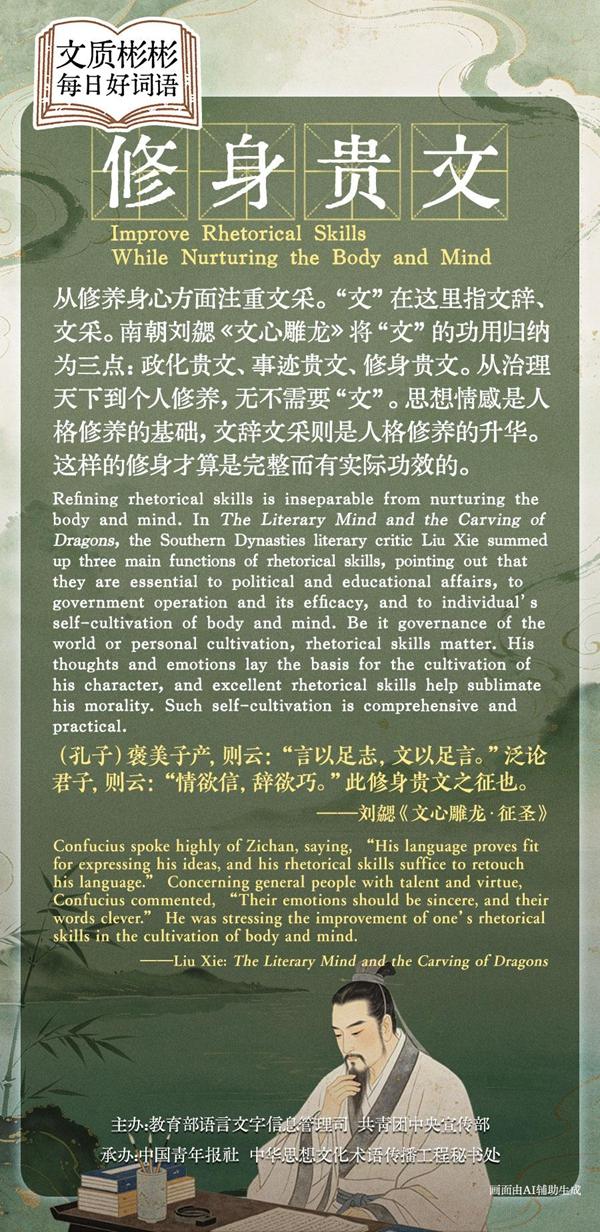
修身贵文
从修养身心方面注重文采。“文”在这里指文辞、文采。南朝刘勰《文心雕龙》将“文”的功用归纳为3点:政化贵文、事迹贵文、修身贵文。从治理天下到个人修养,无不需要“文”。思想情感是人格修养的基础,文辞文采则是人格修养的升华。这样的修身才算是完整而有实际功效的。
Improve Rhetorical Skills While Nurturing the Body and Mind
Refining rhetorical skills is inseparable from nurturing the body and mind. In The Literary Mind and the Carving of Dragons, the Southern Dynasties literary critic Liu Xie summed up three main functions of rhetorical skills, pointing out that they are essential to political and educational affairs, to government operation and its efficacy, and to individual's self-cultivation of body and mind. Be it governance of the world or personal cultivation, rhetorical skills matter. His thoughts and emotions lay the basis for the cultivation of his character, and excellent rhetorical skills help sublimate his morality. Such self-cultivation is comprehensive and practical.
引 例
(孔子)褒美子产,则云:“言以足志,文以足言。”泛论君子,则云:“情欲信,辞欲巧。”此修身贵文之征也。(刘勰《文心雕龙·征圣》)(孔子赞扬子产说:“语言足以表达其思想,文采足以修饰其语言。”概括地谈到有才德之人,他说:“情感要真实,文辞要巧妙。”这是从修养身心方面注重文采的表现。)
Confucius spoke highly of Zichan, saying, "His language proves fit for expressing his ideas, and his rhetorical skills suffice to retouch his language." Concerning general people with talent and virtue, Confucius commented, "Their emotions should be sincere, and their words clever." He was stressing the improvement of one's rhetorical skills in the cultivation of body and mind. (Liu Xie: The Literary Mind and the Carving of Dragons)

来源:中国青年报
2026年07月03日 01版
 放大
放大 缩小
缩小 全文复制
全文复制 上一篇
上一篇