






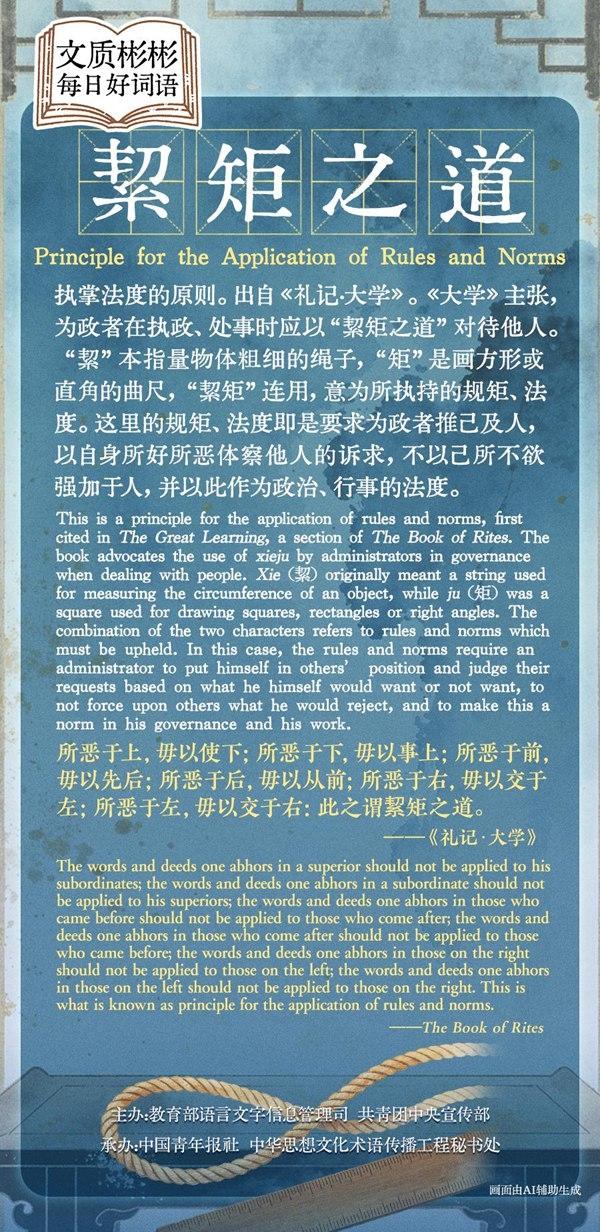
絜矩之道
执掌法度的原则。出自《礼记·大学》。《大学》主张,为政者在执政、处事时应以“絜矩之道”对待他人。“絜”本指量物体粗细的绳子,“矩”是画方形或直角的曲尺,“絜矩”连用,意为所执持的规矩、法度。这里的规矩、法度即是要求为政者推己及人,以自身所好所恶体察他人诉求,不以己所不欲强加于人,并以此作为政治、行事的法度。
Principle for the Application of Rules and Norms
This is a principle for the application of rules and norms, first cited in The Great Learning, a section of The Book of Rites. The book advocates the use of xieju by administrators in governance when dealing with people. Xie originally meant a string used for measuring the circumference of an object, while ju was a square used for drawing squares, rectangles or right angles. The combination of the two characters refers to rules and norms which must be upheld. In this case, the rules and norms require an administrator to put himself in others' position and judge their requests based on what he himself would want or not want, to not force upon others what he would reject, and to make this a norm in his governance and his work.
引例
所恶于上,毋以使下;所恶于下,毋以事上;所恶于前,毋以先后;所恶于后,毋以从前;所恶于右,毋以交于左;所恶于左,毋以交于右:此之谓絜矩之道。(《礼记·大学》)(我所厌恶的上位者对待自己的言行,就不要用它来任使下属;我所厌恶的下属对待自己的言行,就不要用它来应对上位者;我所厌恶的前面之人的言行,就不要用它来对待后面的人;我所厌恶的后面之人的言行,就不要用它来对待前面的人;我所厌恶的右边之人的言行,就不要用它来对待左边的人;我所厌恶的左边之人的言行,就不要用它来对待右边的人:这就是所谓的执政者推己及人、执掌法度的“絜矩之道”。)
The words and deeds one abhors in a superior should not be applied to his subordinates; the words and deeds one abhors in a subordinate should not be applied to his superiors; the words and deeds one abhors in those who came before should not be applied to those who come after; the words and deeds one abhors in those who come after should not be applied to those who came before; the words and deeds one abhors in those on the right should not be applied to those on the left; the words and deeds one abhors in those on the left should not be applied to those on the right. This is what is known as principle for the application of rules and norms. (The Book of Rites)

来源:中国青年报
2026年09月05日 01版
 放大
放大 缩小
缩小 全文复制
全文复制 上一篇
上一篇