





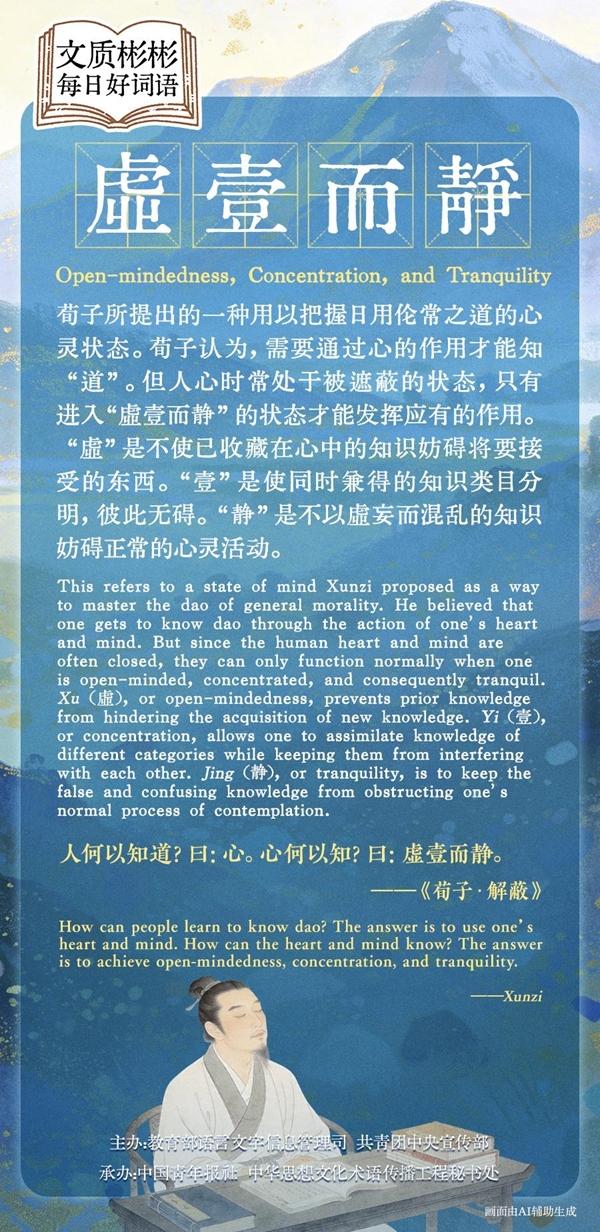
虚壹而静
这是荀子提出的一种用以把握日用伦常之道的心灵状态。荀子认为,需要通过心的作用才能知晓“道”。但人心时常处于被遮蔽的状态,只有进入“虚壹而静”的状态才能发挥应有的作用。“虚”是不使已收藏在心中的知识妨碍将要接受的事物。“壹”是使同时兼得的知识类目分明,彼此无碍。“静”是不以虚妄而混乱的认知妨碍正常的心灵活动。
Open-mindedness, Concentration, and Tranquility
This refers to a state of mind Xunzi proposed as a way to master the dao of general morality. He believed that one gets to know dao through the action of one's heart and mind. But since the human heart and mind are often closed, they can only function normally when one is open-minded, concentrated, and consequently tranquil. Xu, or open-mindedness, prevents prior knowledge from hindering the acquisition of new knowledge. Yi, or concentration, allows one to assimilate knowledge of different categories while keeping them from interfering with each other. Jing, or tranquility, is to keep the false and confusing knowledge from obstructing one's normal process of contemplation.
引例
人何以知道?曰:心。心何以知?曰:虚壹而静。(《荀子·解蔽》)(人如何能够知晓道?回答:用心。心如何能够知晓?回答:做到“虚壹而静”。)
How can people learn to know dao? The answer is to use one's heart and mind. How can the heart and mind know? The answer is to achieve open-mindedness, concentration, and tranquility. (Xunzi)
来源:中国青年报
2026年05月31日 01版
 放大
放大 缩小
缩小 全文复制
全文复制 上一篇
上一篇